 DS Cohen & Associates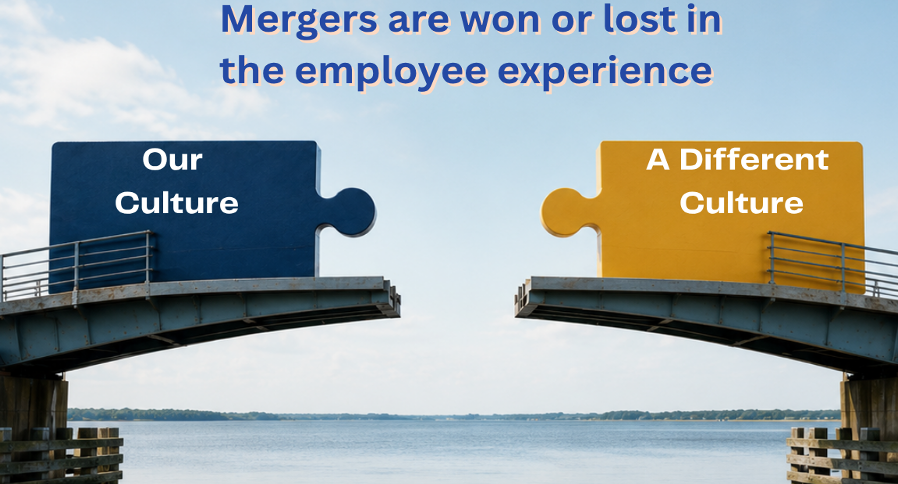
Part One of Two
Acquisition comes with mountains of financial due diligence. Lawyers comb contracts, accountants meticulously review books. The more sophisticated ones add a people layer, human due diligence, usually an employee engagement survey across both organizations.
That survey feels rigorous. It produces a score, a heat map, a number for the slide deck next to the revenue synergies.
And it’s also almost useless for predicting what happens after the deal closes.
A Snapshot, Not a Story
An engagement survey measures a moment. It tells you how people felt the day they filled it out, not why, not what behaviours produced that feeling, and not whether those behaviours survive a different organization’s way of operating.
This is the trap most acquirers fall into. Company A and Company B both show strong engagement, so the deal team calls the cultures compatible. Both companies, in their own way, have built something that works for their people.
The problem is the phrase itself.
One organization earns engagement through consensus and long deliberation. Another earns it through speed and individual accountability. One rewards tenure and internal promotion. The other rewards external hires and fast turnover of underperformers. Both look identical on the survey. Neither captures the behaviour underneath the number.
When the organizations merge, those behaviours collide. Employees who thrived under one set of norms find themselves drowning in another, with no real warning that the rules have changed. Decisions stall because one side expects to be consulted and the other expects to be told. Performance conversations feel foreign because the definition of a good manager was never congruent. The reassuring engagement score said nothing about any of this because it never measured the ongoing experience of working within the organization. It was measuring a photograph.
This is how a deal that looks culturally sound on day one comes apart by year three. The synergies assumed engaged people would stay engaged once folded into another culture. That assumption was never tested because the tool used to test it was not built to do so.
There Is No Such Thing as a Merger of Equals
Leadership almost always promises the same thing at close: the new culture will take the best of both organizations. It is comforting to say on a town hall stage, but it is hardly realistic.
Culture is not a menu. It is a system of decisions: how conflicts resolve, who gets promoted, how bad news travels up the chain. Those decisions cannot be split down the middle. You cannot run decisions by consensus and by command at once, or reward risk-taking and risk avoidance in the same role. Something has to give, and what gives is always one side’s way of working.
This is why there are no mergers of equals. There are acquisitions. Even a deal announced as a merger ends up governed by one side’s leadership, habits, and assumptions about how work gets done. Employees figure this out within six months no matter what was announced, and the gap between the promised blend and the reality of one culture prevailing fuels much of the disengagement that follows.
One Lesson
The Continental and United merger shows exactly how this plays out, and adds a wrinkle: the visible brand and the actual leadership pointed in opposite directions.
Announced as a merger of equals in 2010, the surviving airline kept the United name and livery on every tail, so from the outside it looked as though United had absorbed Continental. Inside, the opposite was true. Continental, the smaller carrier by revenue and fleet size, saw its chief executive, Jeff Smisek, become CEO of the combined company, with Continental’s leadership taking most of the senior roles. The decision-making style and management culture that took hold were largely Continental’s, not United’s.
The external signal indicated that United had won. The internal reality showed that Continental had really won. Declaring plainly that Continental was taking over would have given United’s people a hard truth. But it would have been the truth. Instead they got a story of equals and the reality of an acquisition, and that gap fuelled years of friction.
So here is the challenge. Ask yourself, honestly, what your own due diligence process actually measures: a moment in time or a way of working? Most leaders cannot answer that question, and the ones who cannot are the ones standing on a stage in three years, explaining to a room of stakeholders why a good deal went bad. Part Two asks whether a new generation of AI-powered tools can finally answer that question, and whether their answers deserve to be trusted.
David S. Cohen is the author of “Selecting the Best: Fostering a Workplace Driven by Values for Lasting Success,” amplifies each of the points of this article using a combination of research and anecdotal stories. The appendix contains sample behavioural interview questions. Selecting the Best is available on Amazon and other online book sellers.
