 DS Cohen & Associates
Several years ago, I was working with a company on its values but found myself facing an unusual issue. The CEO did not want to use the word “value”, because he felt the phrase “company values’ was overused and ambiguous. Instead, he wanted to call it Factors for Success. That choice stayed with me. It led me to the conclusion that companies have value only when, without exception, they live it explicitly.
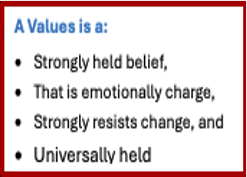
That is a strong claim, and I mean it strongly. We love lists in the corporate world. We love posters. We love laminated language. But values are not translated by, and certainly not manifested through, vocabulary or branding. Values are not what you say when things are peaceful, and the quarter is going well. Values are what you live when times are hard, when it is inconvenient to do so, when it costs you, and when a high performer wants an exception.
Compromising Values
This is why companies keep getting into trouble with using the phrase “core values.” The word “core” quietly suggests a center, or most important value, and then there are all the rest on the outside., This is not necessarily always what leaders mean, but it is often exactly what employees hear. And employees are not wrong to hear it that way. Core implies there could be other values besides the core, or values that can flex under pressure. If an organization truly believes its values are uncompromised ethical standards, then calling them core can accidentally create a loophole: we still believe in the values, but we just made a practical choice this time. This is incongruous with a true value system.
The deeper issue is that many organizations mix two different kinds of commitments and call them all values. The first kind is ethical standards: honesty. safety, respect, dignity, legal and ethical compliance, and the stewardship of customer data. These are guardrails. You do not trade them off. If you do, you have stepped out of bounds.
The Values Exposed
The second kind is business strategy priorities: speed. Innovation, customer obsession, frugality, craftsmanship or transparency. These are real, but they can conflict with each other. Speed can collide with quality. Customer-first can conflict with employee well-being. Innovation can collide with risk control. When a company labels all of these as core, it creates an impossible promise that results in real-life trade-offs. Then people watch the trade-offs, and they learn what the company truly values.
This is the moment integrity gets exposed. Many firms list integrity, honesty, trust, transparency, respect, and accountability as their values. Often, those words overlap. They start to stack on top of each other. The list gets longer, the meaning gets thinner, and the power of the values gets weaker. If integrity already means telling the truth, keeping promises, doing what you say, and not misleading people, then adding ‘honesty’ to ‘integrity’ is not clarity; it is duplication. Trust is often an outcome of integrity, not a separate value. Transparency is often a behaviour that supports integrity, not a standalone moral pillar. A repeating list cannot guide decisions.
Here is my test. Values must function as decision rules. When two commitments collide, which one wins? If the company cannot answer that clearly, it lacks values. All it has are slogans.
This is why I liked Factors for Success. It sounded less like a poster and more like governance. It invited specificity. Factors can be written as boundaries and behaviours. Factors can be audited. Factors can be enforced. Values, as the market uses the word, too often become lost as a motivational wallpaper.
 If a company wants trust, it needs a clean architecture. First, name uncompromised ethical standards by articulating the behaviours that are and will remain the boundaries. State explicitly what can and will never be crossed. Second, name operating priorities as the way the company prefers to work inside those boundaries. Third, publish the conflict rules. Safety beats speed. Honesty beats revenue. Dignity beats short-term performance. Then publish the response rules. When a standard is violated, we name it, we own it, we repair it, we change the system, and we apply consequences consistently, including to senior people and top performers.
Companies do not lose credibility because they are imperfect. They lose credibility because they pretend their values never collide, then compromise and then try to explain it away. If you want values with power, treat them as standards, live them without exception, and let your decisions do the talking.
David S. Cohen is the author of “Selecting the Best: Fostering a Workplace Driven by Values for Lasting Success,” amplifies each of the points of this article using a combination of research and anecdotal stories. The appendix contains sample behavioural interview questions. Selecting the Best is available on Amazon and other online book sellers.
